PinPoint Astrometric Engine 7.0 (32- and 64-bit)
With All-Sky Plate Solving and ATLAS Catalog
Welcome to the web site for the PinPoint Astrometric Engine, a programmable engine that provides sensitive, robust, high-speed research-grade astrometric image processing for FITS files from any camera. A set of point-and-click tools (Visual PinPoint) for fast mass plate solving and survey-level asteroid and supernova hunting are included. Both 32- and 64-bit engines are available.
New with Version 7 is support for the ATLAS All-Sky Stellar Reference Catalog. This large, including Gaia stars and PanSTARRS/APASS magnitudes, has high quality magnitudes, it goes deep, and has proper motions. If you can afford the space, this is now the best catalog for all uses. It is 70Gb for coverage down to magnitude 18 and 160 Gb for coverage down to magnitude 20.
PinPoint 7 also has built-in all-sky plate solving, eliminating the requirement for approximate image centerpoint coordinates and plate scale at the cost of additional time. An internet connection is usually employed for this (see below). PinPoint automatically uses the cloud solving service of Astrometry.Net to find its initial solution, then it takes that as the starting point for a full PinPoint solution including distortion mapping. If you don't have an internet cdonnection, PinPoint can use the 'ansvr' local all-sky server by Andy Galasso. This is all automatic to you and to client programs that embed the engine.
Typical uses include plate solving which gives precise pointing to telescope mounts, asteroid and comet searching, high-precision astrometry (detection and measurement of positions), and other more exotic uses such as space situational awareness. The package comes with Visual PinPoint, a point-and-click Windows program that has automated tools for hands-off asteroid and supernova hunting with optional blinking for validation. You can use Visual PinPoint with any FITS or POSS/DSS images.
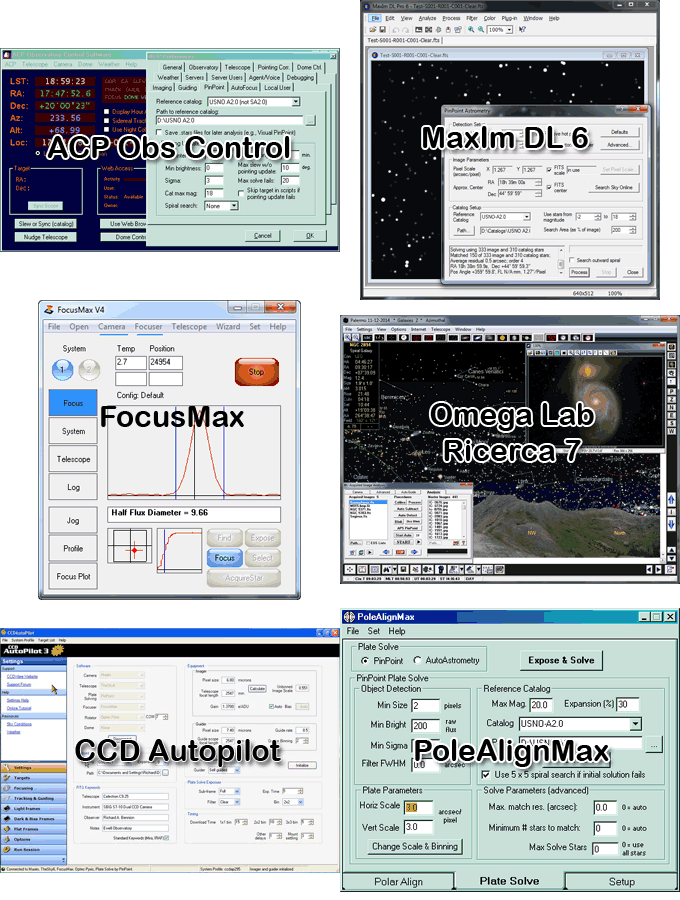
PinPoint is used as the plate solving engine in many astronomy applications out there, including Diffraction Limited's MaxIm DL 6 and MaxPoint, CCDWare's FocusMax and PoleAlignMax, MainSequence's Sequence Generator Pro, Omega Labs Ricerca 7, CCDWare's CCD Autopilot, and of course our own ACP Expert Observatory Operating System.
Concerned about:

Click topics to reveal details.
- Astrometric Accuracy? (as good as it gets)
The numbers speak for themselves. Back in 2002, IAU #333 used PinPoint with an 18" f/2.8 hyperbolic telescope and a 2K by 3K detector at 1.5 arcsec/pixel. The optics produced significant astrometric distortion which PinPoint is able to automatically remove via adaptive higher-order solution. The system was operated in search mode, thus detections submitted to the MPC appear all over the detector field, not just the center. In addition, detections were usually near the noise limit and are hence subject to random variations. Here are the statistics for 2002, #333's busiest year, taken from the MPC's Residuals Statistics for Observatory Codes page. Compare with other observatories, amateur and professional, and remember that many amateur imagers are relatively narrow field and distortion-free, plus many are being used for single target astrometry near the center of the field.
COD  Year       Tot    <1"   <2"   <3"   <4"  <=4"
333  2002     52423 39764 11233  1237   189     0

     R.A.           Decl.
+0.02 +/- 0.66  -0.02 +/- 0.63
These numbers are as good as any observatory out there. And this is across the entire field of a very fast instrument, a worst-case scenario. Furthermore, PinPoint has been improved through many revisions since this data was taken.
- Centroid Measurement Accuracy? (good enough to replicate the Eddington Experiment)
Underlying the astrometric solution and distortion mapping is the accuracy of the X-Y positions of each detected object in the image. This is the basis of accurate astrometry. In 2018, amateur astronomer Donald Bruns replicated the Eddington Experiment which was used to test Einstein's General Relativity by measuring the tiny deflections of stars near the Sun during a Solar Eclipse. Bruns used PinPoint to measure the precise star positions on his eclipse images, made difficult by the solar glow. The result is the most accurate and precise ground-based measurement ever made, with an uncertainty of 3% compared to the theoretical prediction. PinPoint's automated detection and centroid measurements were validated by manual measurements made in another tool and found to be "identical".
- Speed? (faster than anything else out there)
As the size of images increases, the demands on an automated astrometric engine increase steeply. Many of the available astrometry packages bog down when asked automatically match more than a dozen or so stars, or detect stars in a field containing more than 100 detectable stars. PinPoint can handle up to 15,000 field stars, and match thousands of stars, while performing a sophisticated software field-flattening.
The object detector in PinPoint is 400% faster than SExtractor, yet the two packages detect virtually identical sets of objects on a given image, and the XY coordinates agree to less than two tenths of a pixel. This is not to say that SExtractor's positions are "better" and PinPoint only approximates them, tests have shown that PinPoint's positions are more consistent, particularly at low signal to noise ratios.
The following times are approximate times to complete a plate solution without knowledge of the rotation angle of the field (rotation-free solution), and only approximate centerpoint coordinates and plate scales. This is a statistical process, both for the detection of the objects against background noise, and for the catalog-field star matching and astrometric solution process. Numbers and times are approximate, and are for a 1.5GHz class machine running Windows XP:
| Size |
Field |
Catalog |
Match |
Time |
| 512 x 512 |
100 stars |
20 stars |
15 stars |
0.5 second |
| 1024 x 1024 |
1,000 stars |
300 stars |
250 stars |
2 seconds |
| 3072 x 2048 |
10,000 stars |
800 stars |
700 stars |
6 seconds |
| 4096 x 4096(*) |
10,000 stars |
2,000 stars |
1,700 stars |
20 seconds |
- Sensitivity? (as good as it gets)
PinPoint uses an enhanced thresholded peak-finder for object detection, then uses a synthetic circular-aperture photometer to find the centroid and measure the flux of every detected object in the image. Background noise statistics are calculated first, then used to set the peak-finder's threshold in 32 zones of the image. This gives PinPoint a high degree of resistance to image shading. It is quite usable on all but the dirtiest raw CCD frames, though best results are always obtained from properly calibrated images, of course.
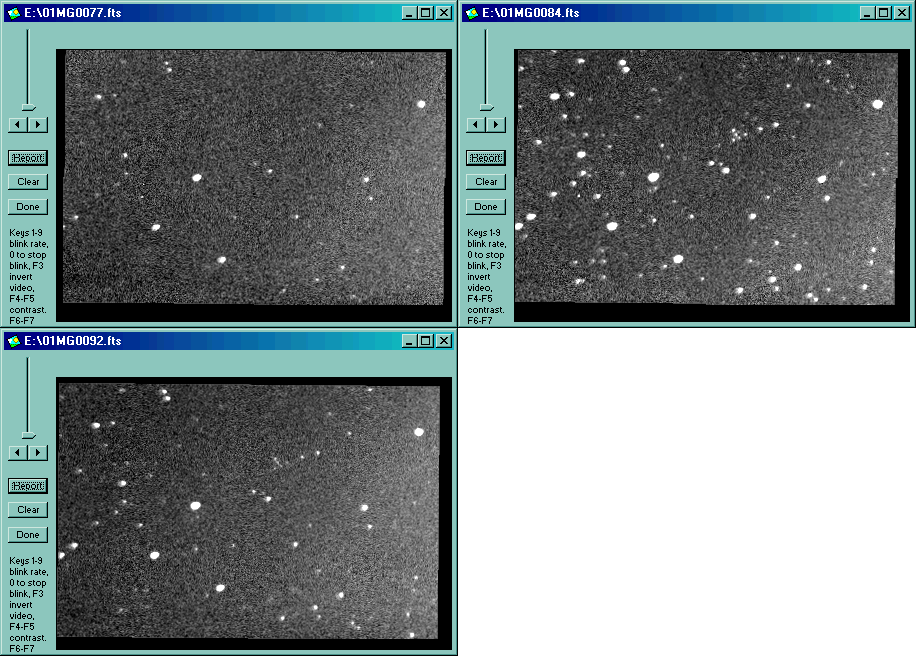
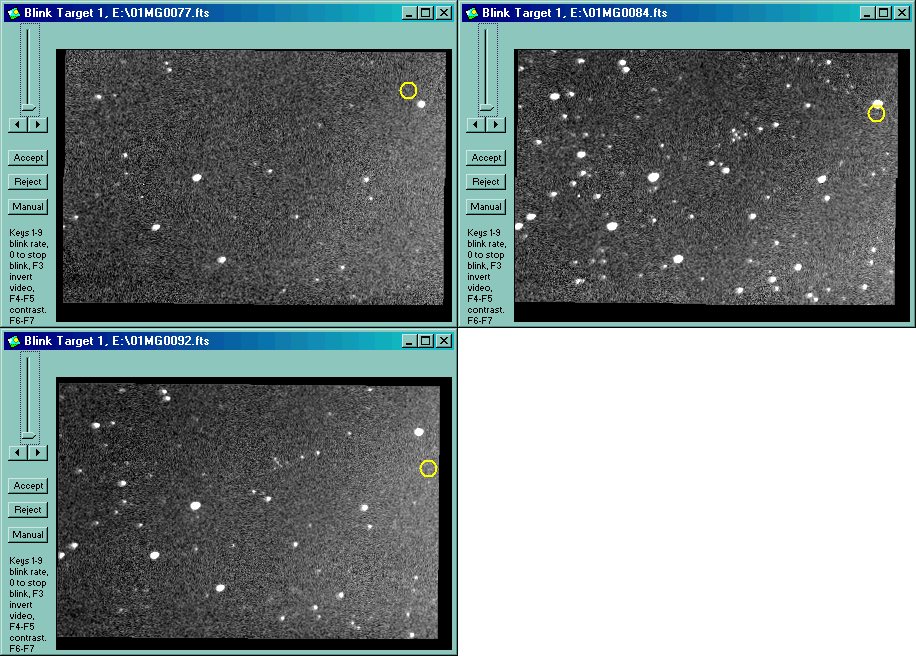
In the following, use the back-arrow in your browser to return here. If you'd like to see what PinPoint can do, click here to see a blinking animation. Can you find any asteroids? Now click here to see the animation of PinPoint's automated detection. Did you find it while manually blinking? Now click here to see the report (including the MPC submission) generated by PinPoint. These images are rather poor, with a wide variation in sensitivity despite being acquired with identical exposure times. This should give you at least some confidence that PinPoint can tackle difficult images.
The best way to evaluate PinPoint's sensitivity is to download a trial package and use the Blink tool to examine some plate-solved images. You can tell which objects are detected by the ones that PinPoint will circle in yellow. Judge for yourself.
- False matching? (an issue with other automated programs!)
There are only a few packages that do automatic image-catalog star matching. Despite requiring you to pre-set accurate values for camera rotation angle (eliminating use on alt/az mounts without a derotator) and focal length, most of these packages still generate false match solutions.
PinPoint virtually never generates a false match. PinPoint can quickly find an image-catalog star match without any knowledge of the camera rotation angle, and with only an approximation of the focal length. It is capable of matching thousands of stars in a single image, thus eliminating the possibility of a false match on star-rich images. It also adjusts its requirements for the number of stars matched based on the number of available stars for matching. This gives it a high degree of resistance to false matches on images with varying numbers of stars, all the way down to matches with only 8 stars.
PinPoint is a trademark of DC-3 Dreams, SP
Copyright © 2004-2021, Robert B. Denny, Mesa, AZ.